Architectural Record
search
cart
facebook twitter linkedin youtube
  • Sign In
  • Subscribe
  • Sign Out
  • My Account
Architectural Record
  • NEWS
    • Latest News
    • Awards
    • Interviews
    • Obituaries
    • Podcasts
      • Design:Ed Podcast
      • Sponsored Podcasts
  • OPINION
    • Book Reviews / Excerpts
    • Exhibition Reviews
    • Forum
  • EXCLUSIVES
    • Videos
    • Design Vanguard
    • Top 300 Firms
    • Sponsored Content
    • Sponsored eBooks
    • From the Archives
  • CONTINUING ED
    • Editorial Continuing Ed
    • CE Center
    • CE Academies
  • PROJECTS
    • Buildings By Type
    • Reuse & Renovation
    • Museums & Arts Centers
    • Colleges & Universities
    • Multifamily Housing
    • Interiors
    • Lighting
    • Kitchen & Bath
  • HOUSES
    • Record Houses
    • House of the Month
    • Featured Houses
  • PRODUCTS
    • Products by Category
    • Record Products of the Year
    • Latest Products
  • EVENTS
    • Dates & Events
    • Record on the Road
    • Innovation Conference
    • Sustainability in Practice
    • Women In Architecture
    • Webinars
    • Ad Excellence Awards
    • Submit an Event
  • CONNECT
    • Ask RECORD AI
    • Newsletters
    • Contact
    • Advertise
    • Editorial Calendar
    • Store
    • Customer Service
  • SUBMIT
    • Submission Guidelines
    • RECORD Competitions
  • MAGAZINE
    • Subscribe
    • My Account
    • Digital Edition
    • Current Issue
    • Firm Pass
    • Historic Archive
Architectural Technology

Hanging Loose

By Russell Fortmeyer
Hanging Loose

Lamar Construction Company

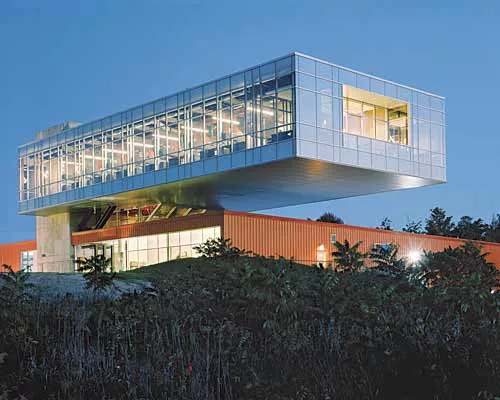
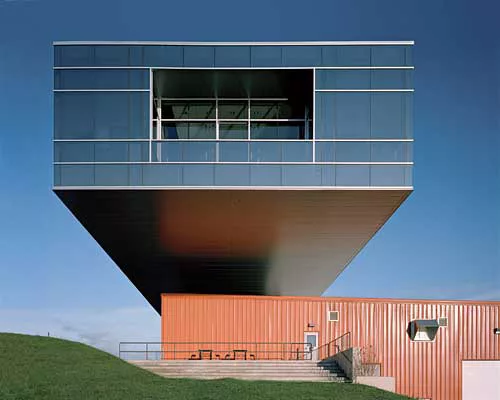
For this small corporate headquarters outside of Grand Rapids, Integrated Architecture developed a 100-foot-long cantilever to lend the project presence from a nearby highway. The client also wanted to highlight its technical expertise through an ambitiously designed and constructed building.

Photo: © Justin Maconochie
Hanging Loose

Lamar Construction Company

For this small corporate headquarters outside of Grand Rapids, Integrated Architecture developed a 100-foot-long cantilever to lend the project presence from a nearby highway. The client also wanted to highlight its technical expertise through an ambitiously designed and constructed building.

Photo: © Justin Maconochie
Hanging Loose

Lamar Construction Company

For this small corporate headquarters outside of Grand Rapids, Integrated Architecture developed a 100-foot-long cantilever to lend the project presence from a nearby highway. The client also wanted to highlight its technical expertise through an ambitiously designed and constructed building.

Photo: © Justin Maconochie
Hanging Loose

Hanging Loose

K Clinic

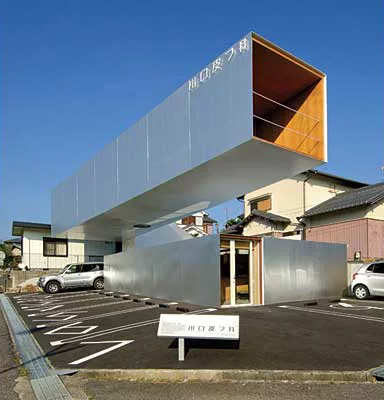
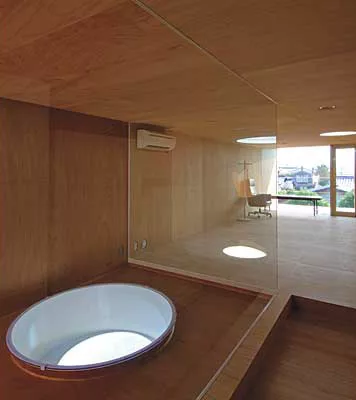
Akira Yoneda's Tokyo firm, Architecton, designed this 55-foot-long cantilever to hold a doctor's private study. Yoneda notes that such structural feats are getting rarer in Japan as designers have experienced increased liability due to structural engineering errors.

Photo: © Sergio Pirrone  
Hanging Loose

Hanging Loose

K Clinic

Akira Yoneda's Tokyo firm, Architecton, designed this 55-foot-long cantilever to hold a doctor's private study. Yoneda notes that such structural feats are getting rarer in Japan as designers have experienced increased liability due to structural engineering errors.

Photo: © Sergio Pirrone 
Hanging Loose

K Clinic

Akira Yoneda's Tokyo firm, Architecton, designed this 55-foot-long cantilever to hold a doctor's private study. Yoneda notes that such structural feats are getting rarer in Japan as designers have experienced increased liability due to structural engineering errors.

Photo: © Sergio Pirrone
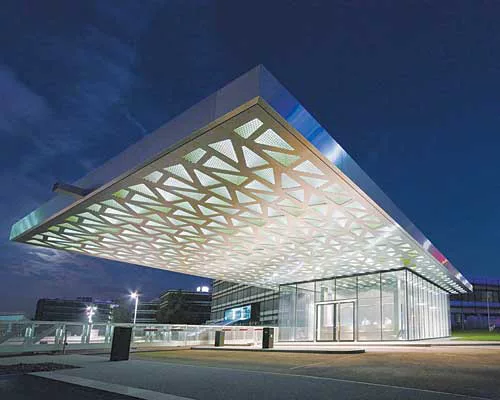
Hanging Loose

Trumpf Gatehouse

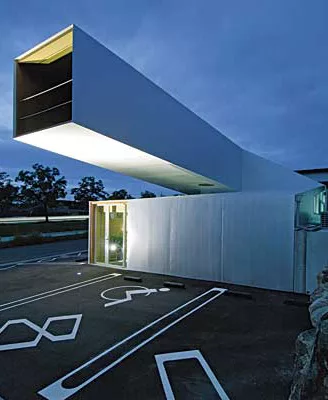
Barkow Leibinger Architects developed a slender, internally illuminated cantilever for the "front door" of a manufacturing complex. The design highlights the client's expertise at laser-cut production techniques, as well as Germany's tradition of precise engineering.

Photo: © David Franck  
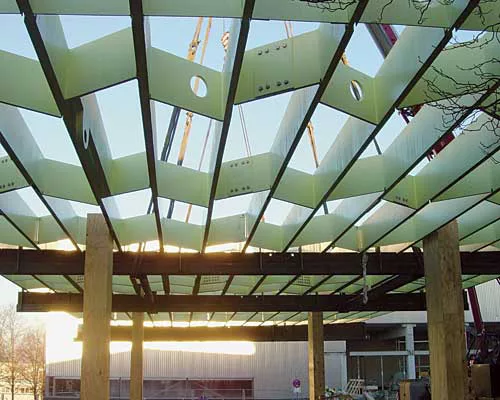
Hanging Loose

Trumpf Gatehouse

Barkow Leibinger Architects developed a slender, internally illuminated cantilever for the "front door" of a manufacturing complex. The design highlights the client's expertise at laser-cut production techniques, as well as Germany's tradition of precise engineering.

Photo: Courtesy Werner Sobek 
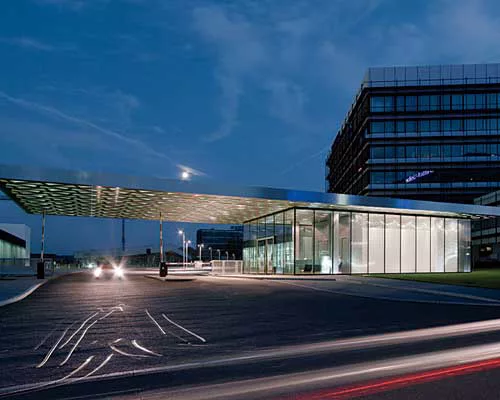
Hanging Loose

Trumpf Gatehouse

Barkow Leibinger Architects developed a slender, internally illuminated cantilever for the "front door" of a manufacturing complex. The design highlights the client's expertise at laser-cut production techniques, as well as Germany's tradition of precise engineering.

Photo: © David Franck

Hanging Loose
Hanging Loose
Hanging Loose
Hanging Loose
Hanging Loose
Hanging Loose
Hanging Loose
Hanging Loose
Hanging Loose
December 19, 2007
Perhaps the most famous cantilever in America is one of the shortest: Frank Lloyd Wright’s 1935 design for the exterior concrete terraces at Fallingwater, the longest of which extends a mere 15 feet to hover over the rush of Pennsylvania’s Bear Run stream. Much has been made of the ongoing structural repairs the cantilevers have needed since they were built, but there has never been a question about preserving them.
 
A good cantilever can make or break a project. Writing in Space, Time and Architecture, Sigfried Giedion saw in Wright’s extensive use of the cantilever a revolution in design, where space becomes an “essential part of the structure, molded as an inseparable part of it.” Cantilevers found widespread favor in the development of Modern architecture in the last century. Mies van der Rohe used them to extend his “universal space” and to further dematerialize the field of vision in his projects. Architects who practiced certain strains of Modernism—think of the hanging corners at Hugh Stubbins’s 1977 Citicorp Center in New York—preferred to disrupt, sometimes unintentionally, architectural stability with the cantilever.
 
Mega-projects with mega-budgets can more readily reach for these spectacular feats of engineering. But smaller projects, when done well, can still retain the power of the cantilever to draw our eye across its gravity-defying expanse. Wright used cantilevers two ways—for overhangs and habitable space—which is how we can think of three new projects completed in 2007 in Michigan, Japan, and Germany.
 
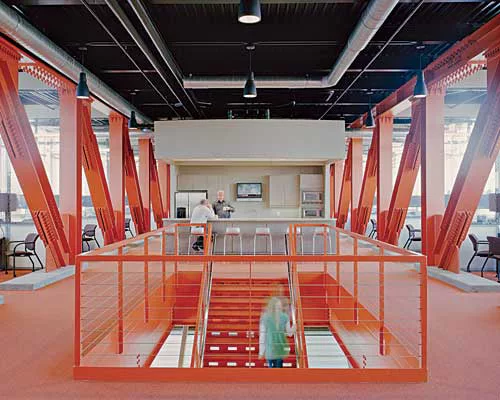
For the corporate offices of the Lamar Construction Company, located outside of Grand Rapids, Integrated Architecture designed a 52-foot-wide and 100-foot-long cantilever for the building’s second floor. Michael Corby, AIA, a principal with Grand Rapids–based Integrated Architecture, says his office had never attempted a cantilevered design such as this. “We used a temporary scaffolding to build the trusses in the air,” Corby says. “We then pulled the scaffolding away and the steel just hovered there,” he says. The building has two volumes separated by a 16-foot gap—a lower, pre-engineered, orange (the company’s signature color) steel box for storage and offices, and the cantilevered glass box for offices and a dining area. The interior of the primary cantilever is defined by the two 16-foot-deep trusses, each of which arrived on-site in three pieces. The trusses, spaced 26 feet apart, were also painted orange. A secondary cantilever extends outward to the edge of the box, perpendicular to the trusses.
 
Paul Dannels, AIA, a principal with Ann Arbor–based Structural Design Incorporated, designed the building’s structural system and considers the cantilever a low-tech solution. “You really just have to buy into the size and scale of the trusses,” he says. The trusses tie into a secondary steel structure contained within a poured-in-place concrete shaft that includes an elevator and a staircase. That steel structure is anchored in a 6-foot-deep subgrade concrete footing, 62 feet wide and 90 feet long. The length of the footing, which extends underground along the horizontal axis of the cantilever, counteracts the tendency of the cantilever to want to pull the building over. All cantilevers, from simple to complex, have to be designed to resist the moment of this force.
 
Additionally, a 4-inch camber was designed into the unsupported end of the volume. Corby says once they pulled away scaffolding, the structure dropped 3¼4 inch. The remainder, 31¼ inches, takes into account other loads. Since the building is located near Lake Michigan, it experiences a high wind load. “It’s unusual to have a building that is so influenced by twist, or torsion of the concrete shaft,” Dannels says. “As the wind hits the building, it wants to turn like a weather vane.” The steel frame in the concrete shaft resists that movement.


Share This Story

Looking for a reprint of this article?
From high-res PDFs to custom plaques, order your copy today!

Russell fortmeyer
Russell Fortmeyer, a contributing editor to RECORD, is a Los Angeles-based sustainability principal at Arup and adjunct professor at the University of Southern California School of Architecture.

Post a comment to this article

Report Abusive Comment

Subscription Center
  • Create an Account
  • Start a Subscription
  • Manage My Account
  • Sign Up for Newsletters
  • Visit Customer Service
  • Update Preferences

More Videos

Sponsored Content

Sponsored Content is a special paid section where industry companies provide high quality, objective, non-commercial content around topics of interest to the Architectural Record audience. All Sponsored Content is supplied by the advertising company and any opinions expressed in this article are those of the author and not necessarily reflect the views of Architectural Record or its parent company, BNP Media. Interested in participating in our Sponsored Content section? Contact your local rep!

close
  • TAMLYN XtremeTrim Exterior Trim
    Sponsored byTamlyn

    Designing Cleaner Panel Facades: Why Exterior Trim Details Matter

  • Building with Vapor Barriers
    Sponsored byReef Industries, Inc.

    Vapor Barriers Help Control Moisture in Tighter Building Designs

  • Duct Interior with Prodeq System
    Sponsored byHenry, a Carlisle Company

    Designing Resilient Water Containment Systems

DESIGN:ED Podcast
Listen to Architectural Record’s DESIGN:ED Podcast

Events

June 10, 2026

Rethinking Stormwater – The Power of Porous Paving

Credits: 1 AIA LU/HSW; 1 AIBD P-CE; 0.1 ICC CEU

Learn how porous paving systems support stormwater management, reduce heat island effects, and enhance sustainable site design performance.

June 11, 2026

Very Early Warning Fire Detection for Mission-Critical Facilities

Credits: 1 AIA LU/HSW; 1 AIBD P-CE; 0.1 ICC CEU

Examine advanced fire detection strategies that support uptime and enhance safety in data centers and other mission-critical facilities.

View All Submit An Event

Products

2026 Architect's Square Foot Costbook

2026 Architect's Square Foot Costbook

See More Products

Popular Stories

Practice Matters illustration

What’s in a (Firm’s) Name? Thinking About Succession and Legacy

Practice Matters illustration

By the Numbers: Counting America's Architects

House on a Hill

Design Vanguard 2026: Forma

Crane Cove, ONO

Design Vanguard 2026 Winners

House A on a Hill

Design Vanguard 2026: Santiago Valdivieso

Broader Sustainability of CMU - Free Webinar - May 21, 2026

Related Articles

  • Hanging Loose

    See More
  • Design Roulette: Architects Set Loose in the World

    See More
  • Malibu High School

    A New High School in Malibu Turns the Tide on Learning

    See More

Related Products

See More Products
  • book5.jpg

    Contemporary Market Architecture Planning and Design

  • image7.jpg

    Contemporary Architecture in China Towards A Critical Pragmatism

  • 1118522532.gif

    Future Details of Architecture

See More Products
×

The latest news and information

#1 Source for Architectural Design, News and Products

SUBSCRIBE
  • RESOURCES
    • Advertise
    • Contact Us
    • Submit
    • Store
  • ACCOUNT CENTER
    • Create an Account
    • Start a Subscription
    • Manage My Account
    • Sign Up for Newsletters
    • Visit Customer Service
    • Update Preferences
  • PRIVACY
    • PRIVACY POLICY
    • TERMS & CONDITIONS
    • DO NOT SELL MY PERSONAL INFORMATION
    • PRIVACY REQUEST
    • ACCESSIBILITY
  • SERVICES
    • Marketing Services
    • Reprints
    • Market Research
    • List Rental
    • Survey/Respondent Access
  • STAY CONNECTED
    • Linkedin
    • Facebook
    • Instagram
    • YouTube
    • X (Twitter)

Copyright ©2026. All Rights Reserved BNP Media, Inc. and BNP Media II, LLC.

Design, CMS, Hosting & Web Development :: ePublishing