Tall Buildings
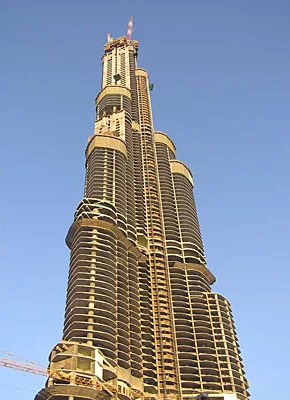
A recent construction photograph of the Burj Dubai, designed by the Chicago office of Skidmore, Owings & Merrill (2008). Once complete, the Burj will be nearly 160 floors and over 2,600 feet tall, making it the world’s tallest building.
Photo courtesy SOM
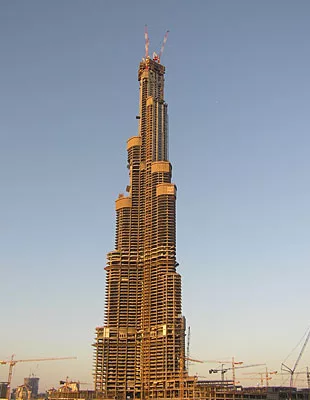
Burj Dubai, Skidmore, Owings & Merrill (2008).
Photo courtesy SOM
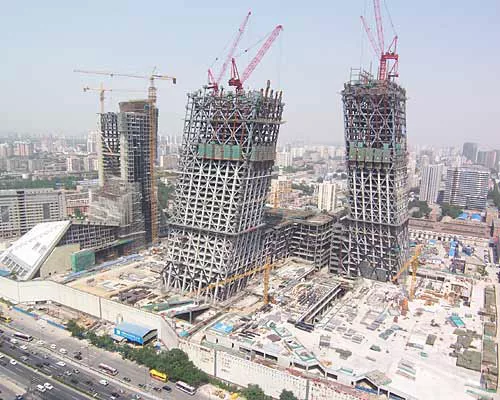
A June 2007 construction photograph of Beijing’s China Central Television tower (2008), or CCTV, designed by the Amsterdam-based Rem Koolhaas and Ole Scheeren for the Office for Metropolitan Architecture, with engineers from Arup’s London and Beijing offices.
Photo courtesy OMA/Rem Koolhaas and Ole Scheeren
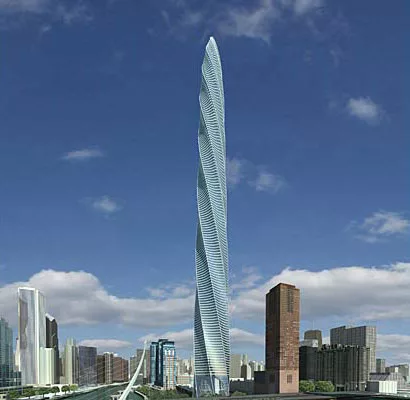
The New York and Zurich-based architect Santiago Calatrava’s design for the 2000-foot-tall Chicago Spire, which once completed will be the tallest building in the United States. The structural engineer on the project is the New York-based Thornton-Tomasetti Group.
Rendering courtesy Santiago Calatrava
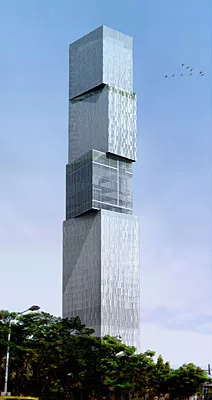
New York-based FX Fowle’s 82-story India Tower, to be built in Mumbai, India, incorporates a number of sustainable features, like partial natural ventilation, and has been designed to retain the massive amounts of water that falls on the site during the monsoon season.
Rendering courtesy FX Fowle
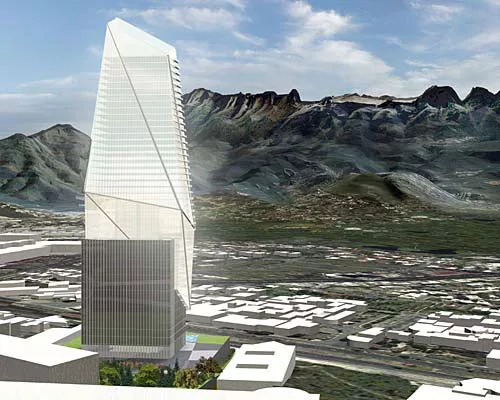
St. Louis-based HOK’s proposed 40-story Monterrey Tower in Monterrey, Mexico, at 590 feet, would rank as the fourth tallest in Mexico upon completion in 2009. The tower, which will accommodate residential and office space, is being designed with sustainable features like rainwater capture, low-flow plumbing fixtures, and a high-performance, low-e glass curtain wall.
Rendering courtesy HOK
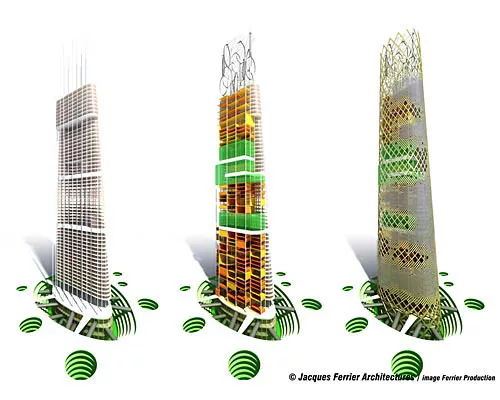
Paris-based architect Jacques Ferrier’s Hypergreen tower is a prototype carbon-neutral skyscraper designed to be built in any major developing city in the world.
Rendering courtesy Jacques Ferrier
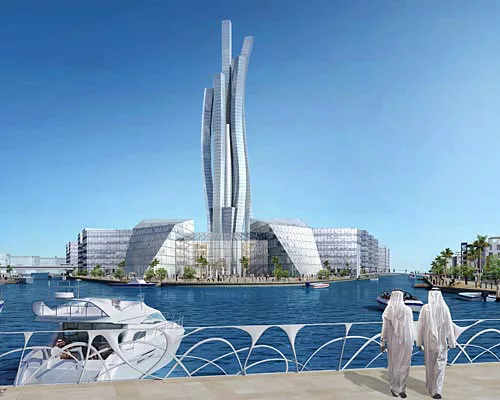
Miami-based Arquitectonica’s Lulu Island tower will anchor a new development on an artificial island in Abu Dhabi.
Rendering courtesy Arquitectonica
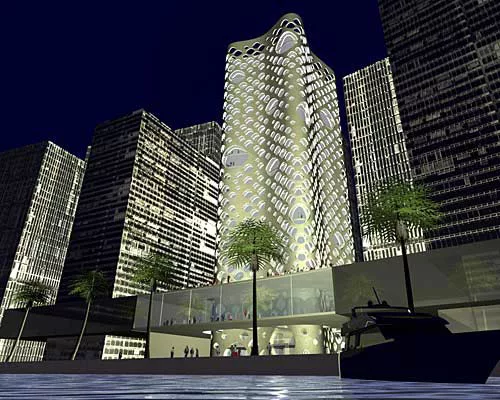
New York-based Reiser+Umemoto RUR Architecture’s O-14 Tower, a 22-story residential tower in Dubai, broke ground in 2007. The building’s skin is a 16-inch concrete shell that will be perforated by 1,000 openings; it acts as both the structure and a daylight diffusing apparatus.
Rendering courtesy Reiser+Umemoto RUR Architecture
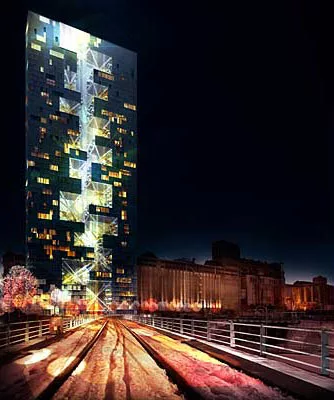
Copenhagen-based JDS Architects’ proposed SILO Tower would accommodate 900 residential apartments for the city of Montreal.
Rendering courtesy JDS Architects
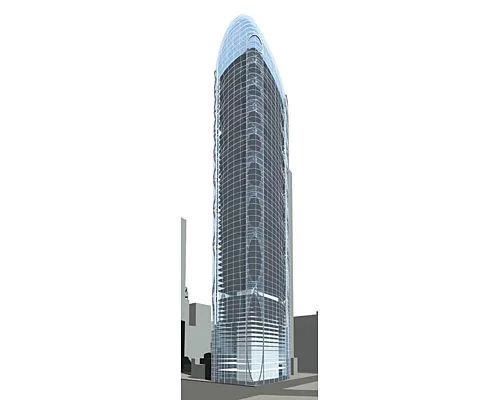
Chicago-based SmithGill Architects’ proposed tower for Chicago will be zero-energy, meaning the building will generate its own power through a combination of technology like photovoltaics and wind turbines, in addition to energy efficient design.
Rendering courtesy SmithGill Architects
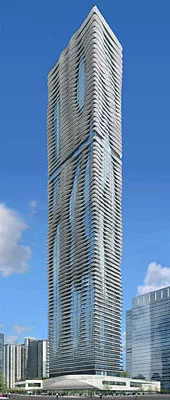
Chicago-based Studio Gang Architect’s 82-story, 822-feet-high Aqua Tower, under construction in Chicago, has a billowing form when viewed obliquely since floor plate sizes shift as much as 12 feet from the building’s perimeter to allow for outdoor terraces. The mixed-use tower, which includes residential, office, hotel, and retail space, will be completed in 2009.
Rendering courtesy Studio Gang Architects
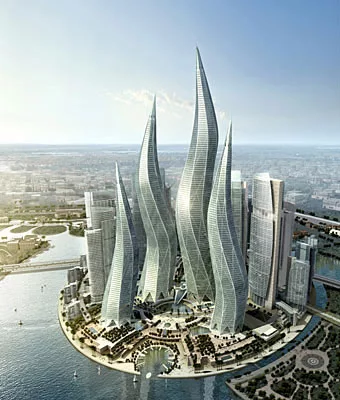
Atlanta-based TVS Architects’ Dubai Towers project, the centerpiece of the massive Lagoon’s project, includes four towers ranging from 54 to 97 floors. The buildings, to be completed in 2010, include residential, retail, hospitality, and office space.
Rendering courtesy TVS Architects
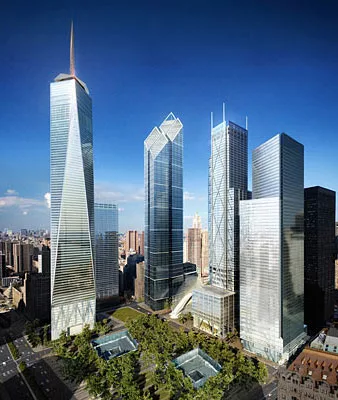
The final plan for the site of New York City’s World Trade Center (WTC) includes four skyscrapers (from left to right): New York-based Skidmore, Owings & Merrill’s 1,776-foot-tall Freedom Tower; London-based Foster+Partner’s 74-story, 1,254-foot-tall 2 WTC; London-based Rogers Stirk Harbour + Partner’s 71-story, 1,155-foot-tall 3 WTC; and Tokyo-based Maki and Associate’s 61-story, 947-foot-tall 4 WTC. WSP Cantor Seinuk is the structural engineer for each tower, except for 4 WTC, which is being designed by Leslie E. Robertson and Associates. Jaros Baum & Bolles is the mechanical and electrical engineer for all four towers. All four towers are being designed to be LEED certified by the U.S. Green Building Council.
Rendering courtesy Silverstein Properties
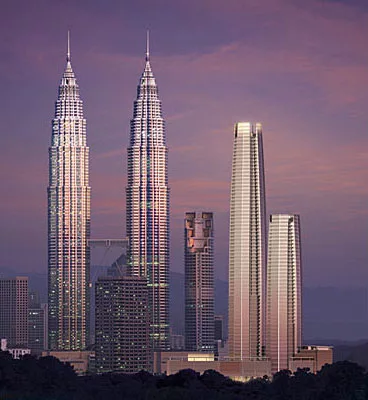
Connecticut-based Pickard Chilton’s proposed 38-story Four Seasons hotel—accompanied by a 60-story luxury condominium tower—for Kuala Lumpur, Malaysia, will anchor a new complex under construction next to the iconic Petronas Towers, designed by César Pelli and Associates (now Pelli Clarke Pelli Architects) and now the second-tallest buildings in the world at 1,483 feet.
Rendering courtesy Pickard Chilton
Topped/Tapped Out
“If you had to cut costs, why didn’t you cut floors instead of corners?”
—Paul Newman, as architect Doug Roberts in The Towering Inferno.
The skyscraper has had more comebacks than Cher. From its humble, naive beginnings in Chicago after the fire of 1871; its idealistic representation in early European Modernism; its apex as the glam symbol of American corporate eminence; its bimbo phase in Postmodernism; its more recent dalliance with high-tech engineering; and culminating with its supposed demise on September 11, 2001, the skyscraper is one helluva contender.
Every time we think we’ve solved the typology, realized its total fulfillment, and built the freshest example, the skyscraper struts out in yet another tectonic version of a Bob Mackie gown—dripping in sequins, devoid of meaning, pure fabulousness. And we can’t turn away.
“The industry is able to build these unusual forms, but we haven’t got our minds around what that means,” says David Scott, a structural engineer in Arup’s New York office and the current chair of the Council on Tall Buildings and Urban Habitat. “People are being too flippant.” Scott worries that although tall buildings can address rapid global urbanization, enough architects and engineers aren’t considering the attendant environmental context in terms of ecological impact. Too often, he says, architects apply sustainable concepts to the existing skyscraper typology, without questioning the typology itself.
Enter the dazzle. We are awash in new skyscrapers, but the typology’s reenergized career banks on one of two design strategies: go really tall or technologically dazzle. Think of it as choosing between Gothic and Baroque, minus the cultural baggage. We can always go tall, though how tall remains an open question. Dazzle is much harder to locate—be it techno gimmickry, stylistic parlor tricks, or a trendy patina of sustainability. The proposals for the World Trade Center (WTC) site were one long, dazzling audition after another for a comeback tour that never happened. Regardless, at any given moment, we can find a skyscraper (or two) to step forward as the repository of our collective wish fulfillment: the Burj Dubai and Beijing’s CCTV Tower.
Structural engineer Bill Baker in the Chicago office of Skidmore, Owings & Merrill (SOM) claims the Burj will be the tallest building in the world once completed in 2008 (around 160 floors rising over 2,600 feet). And Arup’s Cecil Balmond, the lead structural engineer on Rem Koolhaas’s and the Office for Metropolitan Architecture’s CCTV, also to be completed in 2008, has called that building the most structurally complicated he’s ever designed. Tall or dazzling, both towers are icon-making tools, visual propaganda for political states in the throes of expansion. Be careful what you wish for.
The Burj and CCTV also willfully rebuke America’s assumptions of skyscraper preeminence, despite the fact that both projects—like so many others today—represent global design teams with significant American contributions. The computer doesn’t care where you are, and so-called building information models (BIM), heartily embraced by firms such as SOM, Arup, KPF, Buro Happold, and FXFOWLE, promise to further simplify and concretize the collaborative design process. But that is a problem internal to architecture and engineering, entirely solvable through the market (just ask Autodesk and Bentley), whereas getting the tall or dazzling project built remains at the mercy of so many bureaucrats and businessmen.
Market and regulatory demands have become so perilous for skyscraper interests in the States—epitomized by the flawed process at the WTC site—that many domestic observers and fans of the typology have given up expecting anything more than mediocrity, or what we could start calling the “Miami Effect.” Hence, the media has a tendency to skirt past the tiny subject of democracy—not to mention safe job-site conditions and fair employment regulations—when raving about the “just-get-it-done” spectacles of Dubai, Abu Dhabi, Shanghai, Beijing, and so on. Conversely, if architecture needs Communism to realize a project like CCTV, what exactly did it require to accomplish what we are developing at Ground Zero?
Many eyes will stay trained on SOM’s developing Pearl River Tower in Guangzhou, China, the first “net” zero-carbon skyscraper designed to produce its own energy. The project represents the kind of optimism (and PR maneuver) that used to define American skyscrapers—neither the firm’s Burj nor its Freedom Tower at the WTC can compare to the performance-based innovations planned for Pearl River. There are still many in the design world, however, who doubt the project, since true building performance remains somewhat of a guessing game, especially for skyscrapers. It’s telling that there are few, perhaps less than a dozen, proposed tall buildings in the world designed with the strategies of Pearl River. When there is no precedent, clients get nervous.
Looking for a reprint of this article?
From high-res PDFs to custom plaques, order your copy today!