The ArchRecord Interview: Alexander Gorlin
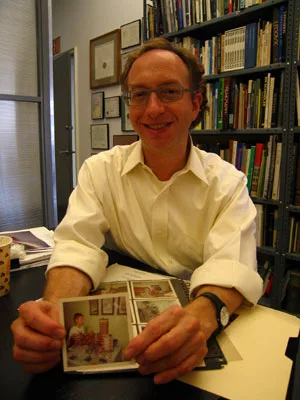
Alexander Gorlin holds a photo of himself as a child constructing a model city.
Photo © James Murdock

The bathroom, with its exposed shower, in the Libeskind residence.
Photo © Michael Moran

The Gorlin, an upscale condominium tower that Gorlin designed for a gated community in Miami Beach, Florida.
Photo © Michael Moran

A residence inside the Gorlin.
Photo © Michael Moran
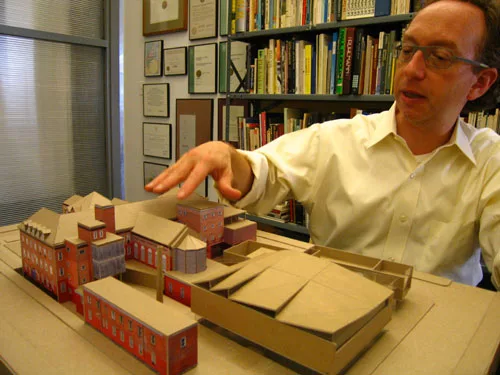
Gorlin discusses a model of an addition to a high school in Brooklyn.
Photo © James Murdock

Gorlin prepared the master plan for schools complex in the Bronx¹s Mott Haven section that includes this school, designed by Perkins Eastman with Alexander Gorlin Architects.
Images Courtesy Alexander Gorlin Architects
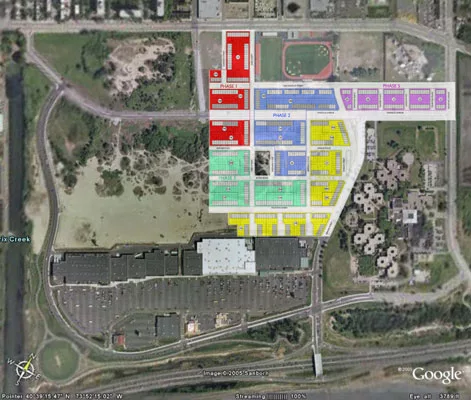
Gorlin designed the master plan for the Nehemiah Spring Creek Prefabricated Housing, an affordable complex for first-time buyers in Brooklyn that, at 700 units, is one of the largest such developments in the city's recent history.
Image Courtesy Alexander Gorlin Architects

The Nehemiah houses are being assembled from prefabricated modular units.
Photo Courtesy Alexander Gorlin Architects

The Nehemiah houses will feature a Modernist aesthetic.
Image Courtesy Alexander Gorlin Architects
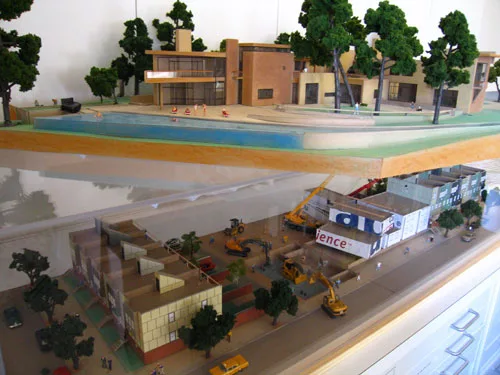
In Gorlin's studio, a model of the Nehemiah houses is the same scale as the model of a private residence in Houston, which rests above it. The juxtaposition illustrates the extremes in Gorlin's client base.
Photo © James Murdock

A rendering of the private residence in Houston, as depicted in the previous photo.
Image Courtesy Alexander Gorlin Architects

The Manhattan loft residence that Gorlin designed for architect Daniel Libeskind and his wife Nina.
Photo © Michael Moran
Alexander Gorlin, FAIA, has wanted to be an architect since the age of seven, when he would fill the floor of his parents’ living room, in Queens, New York, with model cities—complete down to the toy cars and miniature people that populated them. Now aged 52, Gorlin notes that his career has marked a “seamless” progression in scale. As the principal of his own atelier, he designs everything from individual residences to community master plans.
In all cases, Gorlin builds three-dimensional models. They occupy bookshelves, window sills, and nearly every surface in his SoHo studio—successive iterations of buildings punctuated by King Kong and other toy figurines. “I use models almost like sculpture to explore a space,” he explains, “but at a very deep level I consider this play and a continuation of childhood activities.”
Once a mainstay of an architect’s job, model-building has been rendered largely unnecessary thanks to the near photo-realism of computer-generated fly-throughs. But constructing a cardboard mock-up, with its satisfying tactile properties, is Gorlin’s signature skill—and his trump card in convincing clients and other stakeholders to buy into a design. “As long as people have bodies, they can relate to miniatures,” he says.
This much was evident on a Thursday afternoon in late June when Gorlin met with representatives of a public high school to show them his proposal for a 45,000-square-foot addition containing new athletic and arts facilities. The clients were expecting to see three different schemes that they’d eventually present to New York’s School Construction Authority (SCA) for approval and funding. Instead, Gorlin unveiled a model of just one—“because I felt that this was the right answer for this site”—that met the SCA’s code requirements, elegantly resolved an existing circulation problem, and provided opportunities for the surrounding neighborhood to share the new facilities.
“It’s a dream,” said the principal, clearly impressed by a new swimming pool, located below grade but lit by a band of street-level clerestory windows. Gorlin had prepared three different roof treatments: a flat deck with a jogging track and two others, whose slopes reinterpreted the existing building’s gables. The principal swapped one roof for another, satisfied with the result. There was plenty of time to decide on a final scheme; more important, she felt so confident in Gorlin’s concept that she anticipated presenting it at the SCA’s next meeting. “Be sure to call it a ‘community center,’ because that makes it about the neighborhood, not just the school,” he advised.
Building support for a design, it turns out, occupies a large percentage of an architect’s time. Gorlin learned the art of “seducing” clients from I.M. Pei, for whom he worked during the 1980s. “Pei’s body language was always the opposite of what he was saying, so he’d nod his head and smile as he said ‘that’s not what we’re going to do.’” Gorlin reserves this tactic for critical junctures; most interactions are marked by his Woody Allen-like wit. “I’m a psychologist, psychiatrist, political diplomat, and strategist,” he says. “For this job you need all the things that are in those airport self-help books: you know, ‘The Seven Habits of Effective People.’”
Gorlin began that same Thursday, for instance, by meeting with the director of a synagogue-run nursery school, for whom he was designing a new building. Although the project was in early schematics, intended only to help formulate a budget, the director’s attention turned to specific details: would the children’s cubbies be located inside classrooms or the hallway, and was there enough storage space for strollers? Gorlin scribbled notes and improvised solutions directly on the floor plans. He later observed, “She’s just a special interest group within the bigger project, but she was very happy because her needs were being heard.”
The day ended with Gorlin interviewing two candidates for the position of marketing director. During a 20-minute gap between those interviews, he and two other architects reviewed construction photos to see how the finishes looked at a house they’d designed in the Hamptons. Reflecting on his schedule, Gorlin says: “It’s like Robert Venturi once said: you spend only one-tenth of your day designing. The rest of the time you’re in meetings or on the phone.”
If Gorlin’s time is unevenly split between meetings and design, he pursues a consciously balanced approach to the type of jobs he takes. It’s graphically illustrated by the models in his studio: a mansion for clients in Houston rests above a mock-up of the Nehemiah Spring Creek Prefabricated Housing, an affordable complex for first-time buyers in Brooklyn that, at 700 units, is one of the largest such developments in the city’s recent history. Exactly the same scale, the mansion occupies nearly as much area as a block of nine townhouses.
Gorlin describes Spring Creek as “karmic balance” to his work for high-end residential clients. The Taoist-tinged phrase is apt—Gorlin has walked a path between extremes throughout his career. A Classicist while earning his architecture degree at Cooper Union, he later became a Modernist. He left The Yale University School of Architecture, where he taught from 1980 to 1992, to grow his practice—but still finds time to write books and journal articles.
And although Gorlin scores jobs through well-connected clients including Victoria Newhouse, the wife of Condé Nast publisher S.I. Newhouse, and the architect Daniel Libeskind, he also relies on cold-calling. Despite a healthy ego, Gorlin is not above humility. In the days following September 11th, he penned a harsh letter to the editor of RECORD predicting the end of the era of celebrity architects. Within a year, the phrase “starchitect” was coined and big-name designers seemed more firmly entrenched than ever. “I was wrong about that,” he admits.
But something within Gorlin himself changed. He increasingly sought projects like Spring Creek and Common Ground Red Cross Housing, a 200-unit halfway house for homeless people in the Bronx. He also tackled larger developments, such as the Mott Haven New Schools Complex: a cluster of four high schools, co-designed with Perkins Eastman, located on eight acres of former rail yards near Yankee Stadium.
Noble as they are, these projects have been unquestionably good for Gorlin’s bottom line; since 2001, his staff has doubled to 15. Even as the firm grows, he keeps a hand in all aspects of it: from marketing and consensus-building, to design. There are more facets to practicing architecture than Gorlin imagined as a seven-year-old constructing model cities, but he relishes them all. “I have some level of ADD,” he says with a laugh, “so I have to jump between these things to keep my day interesting.”
A version of this story appeared in Engineering News-Record.
Looking for a reprint of this article?
From high-res PDFs to custom plaques, order your copy today!