Peter Marino's Brand Buildings
The New York architect combines respect for the past with a brand's essence in store designs for such luxury names as Dior and Vuitton.
Peter Marino
Photo © Takashi Orii
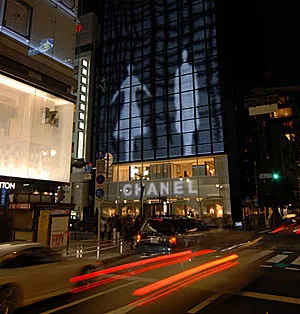
Peter Marino
This fall, Marino's luxurious residential project at 170 East End Ave. in New York opens. So far, 80% of the units have sold.
Photo courtesy Peter Marino Architect
At first, it's easy to mistake the Manhattan office of Peter Marino for an art gallery. The award-winning architect has chosen his sleek, white-walled workplace as the venue to discuss his 10 favorite buildings of all time. His picks include the futuristic, winged Milwaukee Art Museum by Santiago Calatrava, the modernist Seagram Building in New York by Ludwig Mies van der Rohe, and the former Fiat factory in Turin, Italy, which Renzo Piano transformed into an complex of offices, stores, and a hotel.
The front entrance of Marino's own offices doesn't have the look or feel of an architect's studio. It features an abstract painting by the German artist Anselm Kiefer, which takes up an entire wall. An antique Indian statue carved from stone is placed nearby. Across from these works of art, the reception area features several boxy, ultra-modern leather chairs, designed by Marino himself. They're Marino's first foray into retail furniture and part of a new collection for the high-end Italian manufacturer Poltrona Frau, which will hit U.S. stores in September.
The combination of art and architecture is deliberate. "People say my work is sculptural," Marino says as he enters his private workspace, which has large windows and sweeping views of New York City. "But I think it's painterly." The peripatetic Marino, an avid motorcycle fan decked out this day in black leather pants and a black muscle shirt, isn't one to sit still behind a desk. He moves over to a wall, on which are tacked artful sketches and computer renderings for his most recent projects. These include an entire resort on the island of Anguilla for which he's designing every detail, down to the way the bike and footpaths are laid out. He takes down a printout of a computer rendering of another project and carries it back to his desk.
Portrait Painting
"This is a luxury shopping center I'm designing in Calgary," says Marino, pointing to the image on the page. The building's exaggerated rectangular shape is the only clue to the fact that it's, in fact, a mall. The rendering illustrates the layers of stone with which Marino plans to encrust its outer walls and looks more like a stylized interpretation of a high-end shopping center, although it's a literal plan. And when he describes the building site, it's in painterly terms.
"I didn't realize Calgary is so flat. It's like an empty canvas. I was very excited," he recalls. His resulting design, with its subtle yet striking physical reference to the local environment and the area's booming economy, is a 3-D portrait. But first and foremost, it's the latest example of how Marino takes the art of brand building literally.
Widely considered the world's leading designer of flagship stores for the most sought-after and enduring luxury brands, from Dior to Vuitton, Marino is known for staying true to these companies' essences, all the while pushing retail design in dramatic new directions.
At the Fendi stores that opened in Rome and New York in 2005, for instance, Marino used travertine marble as a design detail throughout the boutiques, a reference to the Eternal City's classic architecture (the Coliseum is made from the same type of stone). Marino cut the heavy material using an industrial machine process to achieve an ultra-contemporary effect of geometric waves.
Museum Quality
In his design for Hong Kong's Louis Vuitton flagship (for which he won an American Institute of Architects Honor Award in April), Marino incorporated colorful video projections that are cast on the store's staircase. The projections change hues quickly and theatrically, near window coverings featuring variations of Vuitton's logo turned into decorative patterns.
"Luxury retail should be an experience—a unique and memorable experience," says Marino. His view is that consumers paying premium prices for high-end goods should feel their shopping environment matches the quality and distinctiveness of their purchases. It's a marketing strategy that lures in new well-heeled customers who might be drawn to the spectacle of the stores.
To achieve this effect, he often collaborates with artists to achieve one-of-a-kind environments.
Some of the video projections that resemble Chanel's signature tweed patterns, shown on the exteriors of the Chanel stores in Asia, were created by artist and photographer Michal Rovner, who has shown at prestigious venues such as the Whitney Museum of American Art in New York.
Retail Architecture
Marino's incorporation of contemporary art into his retail design is, of course, a marketing strategy in its own right. Wealthy collectors—hedge-fund managers, Wall Street investors—who frequent art galleries and invest thousands and even millions of dollars in art in today's booming art market are the target customers at a Marino-designed store. The idea is that collectors familiar with artists who have collaborated on the shop's design will be drawn to the shops. The reverse is true, too: artists receive more exposure to potential collectors.
Of course, Marino isn't the first "starchitect" to design luxe flagship stores. Prada boutiques in Tokyo and New York have been designed by Swiss firm Herzog & de Meuron and Dutch architect Rem Koolhaas, respectively. But what sets Marino apart is his ongoing focus on and commitment to retail architecture, an element of his portfolio since he designed the Madison Avenue flagship store for Barneys New York, the high-end department store, in the early 1990s.
Marino has remained connected to the retail arena and refines how architecture can best be used as a very visible and effective brand-building strategy. He employs an in-house research team, among his staff of 150, to hunt down new materials and ideas, such as the 700,000 computer-controlled LED lights used to convert the outside of the Tokyo Chanel store into a giant video screen. And he takes a deep dive into the brand identity of each luxury-goods company he works with, researching historical archives. He even visited Coco Chanel's former Paris apartments for design cues to update with fresh technologies.
"Built to Last"
"Peter's focus has always been on quality and aesthetics. He has never been concerned with following trends or chasing someone else's fleeting definition of cool. When we worked with him, it was always a collaboration. His ideas always successfully embellished our vision," says Gene Pressman, former chief executive of Barneys and author of the forthcoming book Chasing Cool: Standing Out in Today's Cluttered Marketplace, in an e-mail. In other words, rather than design stores that parallel other trendy boutiques or reflect his own signature style, Marino focuses on creating unique, timeless retail environments that remain true to the luxury brand.
"I think most 'Starchitects' are more concerned with making a statement than giving the consumer a pleasant shopping experience," Pressman continues. "But what we [the Pressman family, founders of Barneys] did [with the flagship store] on Madison Avenue was conceived in the early 1990s and is still relevant today. It was built to last. That's what Peter's work is all about."
Looking for a reprint of this article?
From high-res PDFs to custom plaques, order your copy today!