Gold Medal: Renzo Piano
From Beaubourg to New Caledonia, the man and his Workshop have reimagined places for art, culture, people, and commerce.
To understand Renzo Piano’s five-decade-long career, we need to examine his remarkably fluid journey from architectural rebel to cultural establishment go-to man. The bearded provocateur who experimented with movable structures in the 1960s and, with Richard Rogers, inserted a colorful Tinkertoy in the staid center of Paris in the 1970s has evolved into the trusted hand of museum boards and corporate clients. His work no longer challenges the way we view architecture or topples established notions of design, but it impresses us with its refinement and its elegant solutions to the everyday problems of building.

Born in 1937 to a family of builders and contractors, Piano, Hon. FAIA, rejected his father’s trade to study architecture at Milan Polytechnic. He remembers his father asking him, “Why become an architect when you can be a builder?” After earning his degree in 1964, he worked for his father in Genoa under the guidance of the Neo-Rationalist Franco Albini, then spent the rest of the decade abroad in the offices of Louis Kahn in Philadelphia and Z.S. Makowsky in London.
During the 1960s, Piano moonlighted on his own projects, including a series of temporary structures featuring steel space frames wrapped with reinforced-polyester panels. These early pavilions reveal a number of themes that would run through almost all of his subsequent work: a drive to minimize a building’s actual and apparent weight, an experimental approach to materials, an obsession with inventive ways of connecting building elements, and a knack for turning exposed, repetitive structure into poetic form. He also designed a mobile structure to shelter sulfur-extraction work in Pomezia, Italy: Its barrel-vaulted space frame could be moved as mining operations advanced along the landscape. In the 1970s and early ’80s, Piano continued to explore notions of mobility in projects such as an experimental vehicle for Fiat, a mobile construction unit for use in Senegal, and a traveling exhibition pavilion for IBM.
In 1979, he and his first wife, Magda Arduino, developed the Neighborhood Workshop, an experiment in participatory design that would travel to old towns in Italy and help restore crumbling buildings and reinvigorate local building trades. Piano and Arduino designed a cratelike structure that could be transported on the back of a truck, then unfolded so its sides became the floors of outdoor rooms. An easily assembled, tentlike roof provided shade and protection from rain. Instead of relocating residents during the rehabilitation of their town, the Workshop engaged them in the planning and construction efforts and kept them in their homes.
Piano’s investigations in temporary architecture led to his first major commission: the Italian Industry Pavilion at the Osaka Expo in 1970. A tensile structure with a steel frame and reinforced-polyester panels, the giant rectangular building conjured images of a high-tech circus tent. An experiment in prefabrication, the building was shipped to Japan in 15 containers.
International fame came in 1971 when he and Rogers won the competition for the Centre Pompidou in Paris. A controversial selection, Piano and Rogers’s design elicited howls of scorn from conservative critics and defenders of ancient Paris. The architects clearly saw their building as a subversive act, one that would undermine notions of museums as stodgy, inward-looking institutions reserved for the cultural elite. Instead, they designed an enormous contraption with its mechanical and circulatory systems not only running up and around an exposed structural frame but painted in bright colors so you couldn’t possibly miss them. The team also carved out a large plaza from the dense urban fabric of the Beaubourg neighborhood, connecting their building to a public outdoor space that could play host to fire-eaters, buskers, and all sorts of unprogrammed activities. Inside the building, they created large, flexible spaces that would encourage a similar range of ever-changing uses. Because the project’s exterior skeleton reduced the number of structural elements inside, museum curators had more freedom to reconfigure galleries and other interior spaces.
Beaubourg was a huge and immediate hit with the public, attracting 25,000 visitors a day and energizing an entire neighborhood. Even people uninterested in art came to ride the exterior escalators and hang out in the plaza. “When we first met Georges Pompidou,” says Piano, “he told us that the building would stand for 500 years. At that point in our careers, we had designed mostly temporary structures. We said, ‘Oh, my god.’ As we developed the building, we designed it to last 500 years, but imagined it changing every 25 years.”
On Beaubourg, Piano and Rogers worked with engineer Peter Rice, beginning a remarkably fruitful collaboration that both architects would continue in many of their subsequent, separate projects. As Piano tackled major commissions, such as the Menil Collection in Houston (completed in 1986), San Nicola Stadium in Bari, Italy (1987), and Kansai Airport in Osaka, Japan (1994), Rice helped him integrate structure and form in each project. Throughout this period, Piano never developed a signature “style,” but the fusion of engineering with architecture became a guiding principle shaping all of his work. Another force driving his work was a collaborative design process that turned various consultants, fabricators, and contractors into essential team members. As a result, each of Piano’s buildings looked different, shaped by different hands and responding to different sets of user needs and local contexts.
Looking back at Piano’s work in a monograph published in Italy in 1983, Massimo Dini commented, “Piano’s is an architecture of connection, one that tries to create contacts and demolish divisions, barriers; an architecture that fights against the current and is hard to classify amid all the shooting stars of contemporary architecture.”
Many architects who design acclaimed buildings at an early age get stuck in one particular mode or trapped by their own success. Piano, though, followed Beaubourg with a remarkable string of major accomplishments: the Menil and the San Nicola Stadium in the 1980s; then Kansai Airport, the Fiat Lingotto Factory renovation, and the Jean-Marie Tjibaou Cultural Center in New Caledonia in the ’90s; and the Rome Auditoria, the Nasher Sculpture Center, the Beyeler Foundation, Berlin’s Potsdamer Platz, the Zentrum Paul Klee, and the Padre Pio Pilgrimage Church in the 21st century. His ability to tame the enormous scale of Kansai and Lingotto, to express the spirit of the indigenous Kanak culture using a thoroughly modern vocabulary in New Caledonia, and to create exquisite spaces for viewing art at the Nasher and Beyeler demonstrated the range of his talents. Some architects know how to do airports, and others have proved their mettle with expressive designs for idiosyncratic institutions or elegant homes for art museums. But very few can do all of this.
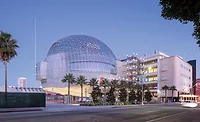
Piano’s sure hand with spaces for art, in particular those at the Menil and Beyeler, has brought him a flood of museum jobs in the U.S., including recently completed buildings for the High in Atlanta, the Morgan Library in New York City, and the Los Angeles County Museum of Art (LACMA), as well as ongoing projects for the Kimbell in Fort Worth, the Art Institute of Chicago, the Whitney in New York City, the Isabella Stewart Gardner in Boston, the Harvard University Art Museums in Cambridge, Massachusetts, and the California Academy of Sciences in San Francisco. But this abundance of plum commissions has brought with it some sour responses from critics. In a story for Bloomberg.com, James Russell said Piano had worn “out his welcome.” And in The New York Review of Books, Martin Filler called the light in one of the galleries at Piano’s new Broad Art Museum at LACMA “gray and gloomy” and criticized his use of color on the outside of the building.
Has Piano stretched himself too thin? Although he recently opened an office in New York City to go with his long-standing operations in Genoa and Paris, he reports that the number of people working for him has remained steady for most of the past three decades, ranging from about 100 to 120 (the current number), and he usually has about 20 active projects at any one time. Perhaps most important, almost all of his seven senior partners (especially Shunji Ishida, who joined Piano in 1971) have been with him for decades.
Some critics point to Piano’s recent projects for the High Museum and LACMA and see a formulaic approach creeping into his work. But projects with similar programs naturally elicit similar designs, especially when key elements such as artworks demand similar kinds of lighting. “Making new shapes is not difficult,” says Piano, “but I don’t believe in making up a new architecture every Monday morning.”
He sees, however, a new architectural language developing for the 21st century. “We understand now that the earth is fragile and our climate is changing,” says Piano. “Our work needs to be anchored to this understanding.” When he mentions recent projects, he invariably talks about buildings that “breathe,” conserve resources, and use less energy. His California Academy of Sciences, nearing completion in San Francisco, for example, recycled 90 percent of the material from the previous building on the site and will have air-conditioning only in areas where animals and plants are displayed or stored. A giant glass canopy over a central plaza will feature microphotovoltaics, while the building’s rolling green roof will support plant species that don’t require irrigation. “Morality informs aesthetics,” states Piano.
“For each project, Piano seeks an appropriate balance between the use of leading-edge, and probably imported, technology and materials with those of the locality and its traditions,” states Peter Buchanan in a 2006 AV Monograph on Piano’s work. “It is all this, along with his uncanny ability both to respond to the immediate context of neighboring buildings and local features and to evoke essential aspects of that culture that makes Piano the only architect operating globally who could claim to approximate the ‘glocal,’ ” says Buchanan.
At 71, Piano shows no signs of slowing down. With major new projects in London, Athens, Chicago, and Fort Worth, he is as busy as ever. And from early photographs of his California Academy of Sciences and renderings of his London Bridge Tower, he seems to be pushing environmental and structural technologies in new and expressive directions. Indeed, these projects show he is still able to surprise us.
Looking for a reprint of this article?
From high-res PDFs to custom plaques, order your copy today!