Piano nobile
Working in Manhattan, I love the idea that we accept the clear and simple geometry of a building. We accept that logic. But complexity comes from texture, from vibration to change, to breath. Sometimes buildings even make sounds.

Speaking at his offices at the Renzo Piano Building Workshop near Genoa in an interview with Architectural Record in 2001, the architect described his hopes for a building still in design—the New York Times Tower. The completion near Times Square of a new, 52-story tower—home of the country’s premiere news daily at Eighth Avenue and 41st Street—coincides with the news that on December 13, Piano was awarded the 2008 Gold Medal by the American Institute of Architects. The confluence of peer recognition of this former Pritzker winner, broad media attention, and tall architecture in record’s backyard provokes ruminations on fame: Is a starchitect worth the hype?
In Piano’s case, as the Times tower attests, the answer resounds positively “yes!” This most thoughtful and responsive architect, whose projects have ranged across a diverse array of clientele, geography, and solutions, defies easy categorization. In his attempts to find unique solutions to time and place, his form making has produced both the memorable and the occasionally awkward. However, what we most admire in a Piano project is not predetermined form so much as his essays in materials and light.
Think of the range of architecture he has produced since the colorful Centre Pompidou at the heart of Paris in 1971 with Richard Rogers, from the mellifluous Center Jean-Marie Tijbaou in Noumea, New Caledonia (1998), to the hyperefficient, razor-cut Kensai Airport in Osaka, Japan (1994). A favorite of museum building committees and patrons, Piano offers surprising range, from the undulant topography at the Zentrum Paul Klee in Bern, Switzerland (2005), to the diaphanous at the Fondation Beyeler near Basel (1997), or the spare, vaulted Nasher Sculpture Center in Dallas (2005). These projects vary according to the collections and public access, yet each revels in studied, particular detail.
New York has been the proving ground for Piano’s first tall building in the United States. Here, the Times Tower manages the transition from the gritty street to the skyline in a veiled leap. Building on his earlier work with ceramics and glazing at Berlin’s Debis Tower (1997) in the reconstituted Potsdamer Platz, the architect has cloaked the Times’s walls with a see-through scrim of ceramic rods over an X-braced steel framework and a sophisticated curtain wall. From a distance, the soft gray tower joins the musical dialogue of Manhattan’s assertive skyscrapers, punctuated by a nonfunctional, whipsaw vertical rod. While the top floors seem to lack an adequate transitional step-up to the stars, the tall building nevertheless stands resolute, engineered for presence and personality.
Grounding the total enterprise, a four-story newsroom surveys an interior courtyard of birch trees and moss, relating the structure to historic Modernist antecedents from the golden ages of Mies and SOM. Moving from the Venetian-plastered lobby out to the finely detailed atrium, looking up toward the multitiered newsroom, comparisons with Lever House and other corporate icons from the mid-20th century seem inevitable. Familiar, though highly honed, territory.
A remarkable transparency characterizes the structure. At night, trudging past the offices along Eighth Avenue, we can see people moving through the spaces. Employees on upper floors or visitors to the double-height 14th-floor cafeteria can see clearly through the veil of rods, which provides a measure of shade and shadow, with stunning views out to Manhattan and New Jersey, until further towers appear nearby. Corridors become airy axes, opening out to the larger city. Computer control manages shading from too much sunshine.
Remarkably, this project involved the complex calculus of the developer—Forest City Ratner—and the primary tenant—the New York Times Companies—with an architectural collaboration, pairing Piano with FXFowle. On joining in the enterprise, working strong ideas together over time, Bruce Fowle has noted, “Although unaccustomed to a supporting design role, we saw this prospect of teaming with Renzo as a rare opportunity to break the malaise of American commercial high-rise architecture. It didn’t disappoint.”
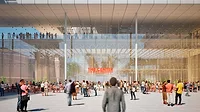
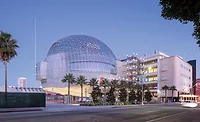
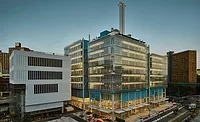
Piano’s ability to navigate complicated programs and his interest in urban design has brought him increasingly complex commissions, from his work at the Genoa waterfront to Berlin. For the controversial 17-acre expansion of Columbia University in New York City’s Manhattanville neighborhood (with SOM), the proposed plan elevates a new campus above the street. Major projects in San Francisco (the expansion at the Academy of Sciences), Chicago (for the Art Institute), and Los Angeles (LACMA), will all debut in coming months.
Answers to the question raised in the first paragraph, that of fame, seem self-evident in Piano’s work. He has achieved recognition not because of a publicity machine, nor flamboyance, but because of the seriousness of his inquiries, the responsiveness and respect for his projects, and his architectural skill. How trivial it would be to limit Renzo Piano to the cheap term “starchitect.” Master builder, professore, Gold Medalist—all suit him better.
If you wish to write to our editor-in-chief you can email him rivy@mcgraw-hill.com.
Looking for a reprint of this article?
From high-res PDFs to custom plaques, order your copy today!